The State of Israel no longer believes in settlement.
Maybe a bit of strengthening the periphery — a neighborhood here, a railway there. But serious settlement, the kind that changes the demographic balance, the kind that establishes dozens of new communities and adds more points of light to the map of the country — that is no longer happening.
And it is not only the state as an institution that has stopped believing. Many of my very best friends, Zionists to the core, oppose it as well. Sometimes for social reasons, like “today’s challenges are social, not about settlement,” or for green reasons, like “new settlement shrinks the remaining open spaces and harms nature.”
Talking today about founding new communities in the Negev and the Galilee is almost politically incorrect. And so, building a neighborhood of 16,000 apartments (!) in Rosh HaAyin takes just a few years, but settling a few dozen families in a new community in the Negev is a ten-year story at best and a “never” at worst (see the communities of Shizaf, Ir Ovot, Hiran and others…). The settlement movements are doing amazing work, as best they can, but against the state’s lack of support and the unfathomable piling-up of obstacles to founding a new community, the balance is far from changing.
So here it is, out in the open: I believe we need to establish many more new communities in this country in general, and in the Negev in particular. And not only out of pioneering romanticism (though I admit that five caravans in the heart of the dunes bring tears to my eyes), but because in my view it is a social obligation, a demographic obligation, an obligation for forging the spirit of the nation, and even — believe it or not — if done right, it can help nature. Here goes:
1- A Zionist demographic obligation:
The clustering into the state of Gush Dan is a disaster, and we are losing the Jewish majority in most parts of the country. Anyone serious must read Prof. Arnon Soffer’s book “The State of Tel Aviv — An Existential Threat to Israel” (link in the first comment). A choice quote from the introduction: “The northern coastal plain, the mountainous Galilee, the Jezreel Valley, the entire mountain ridge and the northern Negev are being abandoned by Jews, or Jews never reached them at all, and Jewish sovereignty there is steadily weakening. If this trend continues, Israel will, with its own hands, implement the UN partition plan of 1947, and worse still — the Morrison-Grady plan of the early 1940s, and will withdraw into a narrow strip along the coastal plain alone, where life will be unbearable because of congestion and chaos. The conclusion is clear: contrary to every familiar and understandable global process, Israel cannot accept trends of clustering into the core at the expense of the periphery, while at the same time hoping that its Zionist-Jewish sovereign borders will not be gradually eroded, up to the point of no return.”
2- A social obligation:
Some say we should be dealing today with social problems. Settlement was the previous generation’s challenge — today it is social. I agree. But in my eyes, settlement is the most social act there is. This or that social enterprise performs cosmetic surgery — whereas massive settlement in the Negev is a fix at the root. The main reason there are people in development towns who feel they live in the “periphery” is that they were placed there by force in the 1950s; no one asked them. If you ask a child in Ein Yahav or Sapir whether they feel they live in the periphery, they won’t understand what you are talking about, even though these are the communities farthest from any urban center in the country. Why? Because their parents chose to live there — and so, as far as they are concerned, it is the center of the world. They live there by choice. Therefore, righting the wrongs in the Negev begins first of all with bringing masses of settlers who come by choice, not out of flight or coercion. That is the foundation. Along the way, the high-tech, the industry and the cultural institutions will follow. For example: if a bloc of “Arif communities” rises west of Mitzpe Ramon, and a bloc of “Meishar communities” on the vast plain south of Makhtesh Ramon (the names are mine, because sadly the State of Israel currently has no plan whatsoever to settle there), Mitzpe Ramon will turn from a remote town with no hinterland of surrounding communities into a mother town that provides services and serves as a cultural and technological center for thousands of people living by choice in those communities. Everyone wins.
3- People connected to their land:
Some say — why not live only in cities and towers so that we have more “open spaces”? Why do we need rural communities at all? What an outdated notion! Well, I recently found a wonderful article by Ben-Gurion that answers exactly this:
“Anyone who has studied the history of Rome remembers the drastic chapter called the Punic War. Hannibal of Carthage was one of the greatest commanders in the history of nations, and perhaps the greatest of them all… He was ultimately defeated, even though the generals who faced him were mediocre and talentless. Roman mediocrity ultimately triumphed over Carthaginian genius. For Carthage was a city-state and Rome was a village-state, and in the desperate struggle between a city people and a village people, the village people won. And all of Carthage’s commercial wealth and all the genius of its commanders were of no avail. Hannibal’s valor was broken by the stubborn war of Rome’s farmers. These farmers did not recoil from the heavy defeats they suffered one after another, for they were rooted in the soil and bound to their land.” (Ben-Gurion, 1935, “Our Work and Our Way”).
City dwellers are the growth engine of the State of Israel. But — and it is a big but. For a people more connected to its land, that understands the bond to the land in its plainest sense — through agriculture and the Israeli landscape it sees from its window every morning — we need a critical mass of village people. Farmers, or in any other profession, for whom the bond to the land is self-evident, with no explanations, no hairsplitting and no love-of-the-land workshops. Simply because it is their land. Let us be Rome, not Carthage. And what can you do — even if it is not politically correct, it must be said: in the army’s field units there are far more sons and daughters of moshavim, kibbutzim, small communities and small towns than people from the big cities. Because the field and the open terrain are closer to them. The other units are needed no less, of course, but you cannot win, or build a stable and strong society, without the rural foundation.
4- Protecting nature:
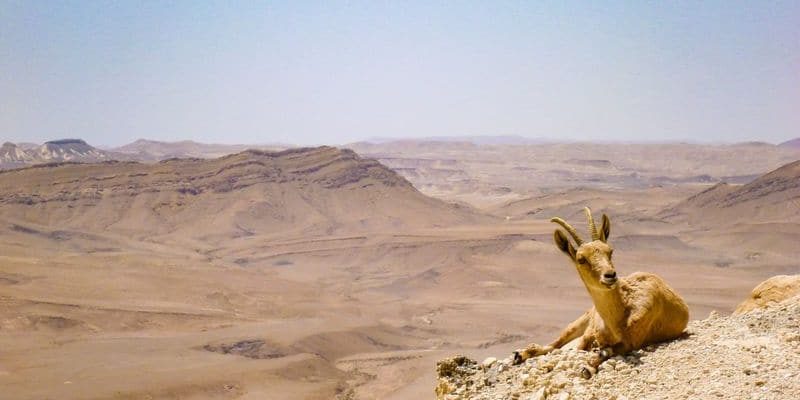
One of the main counterarguments is that founding new communities harms nature and the open spaces. In my view, the opposite is true. A brief example: until the 1950s, the Arava region had herds of thousands of gazelles, ibex, leopards and more… Why did most of them disappear? Because of settlement?
Here are the facts: Giora Ilani, one of Israel’s greatest naturalists (who lived and is buried in Sapir, the community where I live), describes in the book “Ma’ale Namer” the great extinction of the herds of large mammals in the Arava. It was carried out mainly by IDF soldiers and Bedouin tribes (a heartbreaking account of this is worth reading in his book). However, from the moment settlement in the Arava began, mainly from the 1960s onward, the mass extinction was halted. As settlement flourished, and with the presence on the ground of settlers who care about the land, the animal population of the Arava region grew, and thanks to various initiatives, animals that had vanished from it during the great lawless years before settlement were released back into the Arava — oryx and wild asses that can be seen today in the Negev and the Arava. In a word: no settlement — chaos and the destruction of nature. With settlement — a relatively tiny area goes to the community itself, while most of the land gains protection and the flora and fauna flourish again (with proper planning, of course). Sometimes the world does have win-win situations.
And who will settle? Hundreds and thousands of young people, some of whom I know personally — they are just waiting for such a mission.