
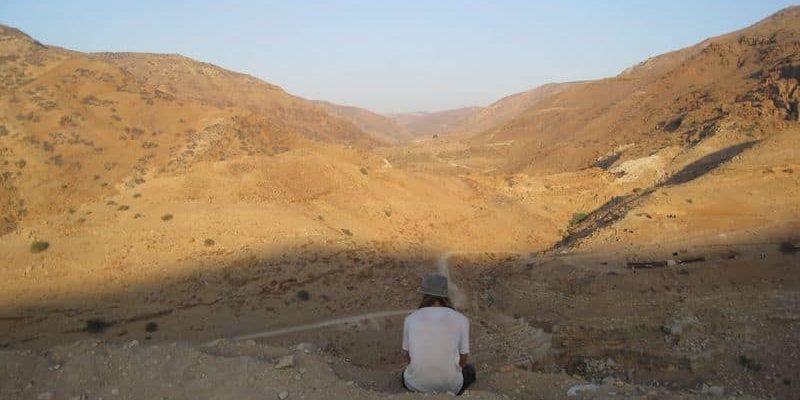
Only when I was there did I understand. We stood at Tel Penuel, the place where Jacob wrestled with the angel and the place where we received the name Israel. We arrived with our questions prepared: why does Jacob cross the Jabbok stream southward, straight into Esau’s furious army? Why the urgency to get up and cross the stream in the middle of the night? If the final destination, as becomes clear later in the story, is the Sukkot Valley and Shechem, why cross the stream at all?
(It helps to use the attached map I prepared in order to follow along.)
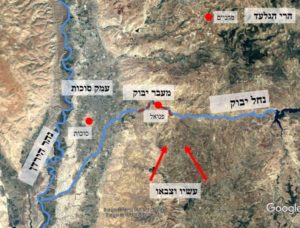
The questions gnawed at our minds, and the best way to answer them was to go out to the place where it all happened. Tzuriel, Dvir and I set out on a journey in the footsteps of Jacob’s wanderings in Gilead. After a picturesque visit to the village of ‘Mahna’, identified with Mahanaim, we descended to the Jabbok stream. In the middle of the stream, five kilometers before it spills into the valley, lies Tell adh-Dhahab, identified with Penuel. Here, we are told, Jacob wrestled with the man of God: “And Jacob called the name of the place Peniel: for I have seen God face to face.” The stream flows at the foot of the ancient city of Penuel. The current is not strong, and today much of the water is sewage. Even if we take into account the extra water that flowed in the past, before the Jabbok dam was built, the stream is not powerful, and crossing it can be done with great ease in twenty seconds over a few stones, without even getting wet
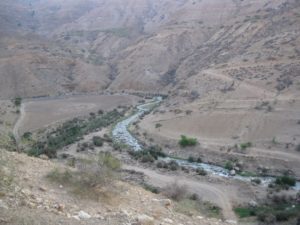
But we grew up on a mythological crossing of the stream; from the description of the “Jabbok crossing” you might think it was a raging river that would be a very serious undertaking to cross. We had always imagined Jacob crossing the stream back and forth to make sure his whole family got across, until he remained alone on the far bank, distant from his family. But when we stood in the stream itself, we saw that the distance from bank to bank is just a few meters. Jacob could have let out a single shout and Reuben and Simeon would have come at once to help him. Something here did not add up. It seemed that the interpretations about crossing a raging river came from the notion that this was some European Rhine or Danube — and not our little Jabbok.
We sat on Tel Penuel, opened maps, leafed back and forth through the Tanakh, and then the realization landed on us and solved all the questions.
The Jabbok crossing is not the name of the spot where Jacob crossed the stream. There is no point at all in calling a crossing point “the Jabbok crossing,” because this is a stream with a relatively weak flow that can be crossed anywhere, not only at one specific ford. Rather: the Jabbok crossing is the name of an entire section of the stream, five or six kilometers through which the road to the Sukkot Valley passed.
Let us explain: from the mountains east of the Jordan, four huge streams spill into the rift valley — the Yarmouk, the Jabbok, the Arnon and the Hasa (mistakenly identified as the Zered stream). Although one would expect major roads to run along these streams from the mountains down to the valley, in practice this was not possible: the Yarmouk gushed with water in a canyon-like channel, the Arnon had a large, impassable waterfall, and Wadi Hasa had a series of small falls and boulders that allowed no comfortable road.
But not so the Jabbok. The Jabbok’s channel is quite wide and its flow is not too strong. And so a comfortable road ran through the Jabbok, connecting the Jordan Valley to the mountains of Gilead. However, the final section of the stream was slightly narrower and canyon-like. That section was called — the Jabbok crossing.
In other words, when Jacob passes through the Jabbok crossing, he is not crossing the watercourse — he is simply passing through the narrow, dangerous canyon section of the stream before it spills out into the Sukkot Valley in the Jordan Valley.
“And he rose up that night, and took his two wives, and his two maidservants, and his eleven sons, and passed over the ford of the Jabbok. And he took them, and sent them over the stream, and sent over that which he had.”
Now things became clear. The questions were solved.
Jacob descends from Mahanaim, north of the Jabbok, and finds himself inside the Jabbok stream at precisely the critical moment, as Esau and his army draw near. Jacob relies neither on a miracle nor on Esau’s good heart. He prepares for war as well. The worst thing for him would be to be caught on the inferior ground, in the canyon channel, during the battle with Esau. The situation is urgent. He urges his family to pass through the narrow section of the “Jabbok crossing” that very night. They walk those six kilometers in order to reach the great plain of the Sukkot Valley — where the battle with Esau would not be fought from a position of weakness. Jacob, like a good commander, stays last in the dangerous terrain. The rest is known: the family had already moved on and left the narrow section, while Jacob remained last, far from his family — and met, face to face, the man of God, in the struggle that gave us the name — Israel.
The questions were solved. Jacob did not cross the stream southward toward Esau’s army, but westward toward the land of Canaan. Jacob had to get his family out of the inferior ground — hence the urgency of walking in the middle of the night. This also explains the Sages, who said that Jacob prepared with gifts, prayer and war. Gifts — the presents he gave Esau. Prayer — his prayer to God, “Deliver me, I pray thee.” But how did he prepare for war? This understanding explains it. He prepared for war by improving his position ahead of the battle with Esau. A battle that, in the end, never happened.
We are privileged to live in a generation that has one of the best commentaries on the Bible — the land itself. We will struggle and wrestle until the sun rises upon us. We have already striven with God and with men — and we shall prevail.
Thanks to my companions on that excursion some years ago, Dvir Raviv and Tzuriel Asaf


