

How can one truly connect to the symbols of the past, of the destruction? If Ben-Gurion, Moshe Dayan and Yigael Yadin all took the trouble to reply by letter to a 17-year-old girl, the matter must have been of the utmost importance:
And what was the burning issue?
The fear of the young girl, Ilana Eiland, that there would be — heaven forbid — a cable car going up to Masada.
Masada — the place where the Great Revolt of the Jews against the Romans came to its end. The same Masada where the last of the rebels fortified themselves and held out for three years after the Second Temple was destroyed.
And this wonderful story about the girl who opposed the cable car was sent to me by Hagai Weisbrod, Ilana’s son.
Ilana was born in Kfar Hess in the Sharon in the year the State was founded. At seventeen she made the ascent to Masada with her youth movement, like many of her peers. The grueling trek up the Snake Path, ending at Masada, was the ultimate rite of passage for becoming true Sabras.
The winding, steep Snake Path that climbs the mountain is very ancient, dating back to the days of the Zealots at Masada. But Ilana could not help noticing something: the Snake Path had been widened to make it more comfortable for hikers.
That evening she sat in the camp and thought to herself: it was only through the grueling climb that I managed to grasp the greatness of Masada. And now — it starts with widening the Snake Path, next there may be kiosks here, and in the end maybe even a cable car?!! How far downhill could this go?! Masada must be ascended only on foot, feeling the effort, the sweat; only out of that can one understand this symbol at all.
On returning from the trek, in eleventh grade, she took pages from her notebook, sat and wrote, erased, corrected and wrote a letter. In the late winter of 1965 Ilana copied the letter out in three copies on loose notebook pages, put them into three plain white envelopes, stuck on stamps, added the addresses, and finally, with awe and trembling, dropped them into the mailbox of the village secretariat.
On the envelopes were written three addressees: David Ben-Gurion, Moshe Dayan and Yigael Yadin.
And this is what she wrote:
24.2.1965
I am a student at the regional high school in Emek Hefer, in eleventh grade. Yesterday I returned from a trek in the Judean Desert, in the course of which we hiked around Masada and came to know its surroundings, and please allow me to turn to you about a matter that has been troubling me for two days. I had heard much about Masada even before, I had read about it and knew it, yet despite all that I felt nothing; perhaps I did not understand how I belonged to it, I did not feel its greatness. On this trip we arrived toward evening at the foot of Masada.. South of Masada the speech of Elazar Ben-Yair was read to us, and at that moment I felt the heroism of Masada. I do not know what I felt, but in those seconds I saw Masada as every Jew must see it… Only then did I see its solitude, the power of the cliffs. At its summit I managed to feel the terrible heroism of its heroes.
…Only in the evening, after we heard another lecture about Masada, did I remember having heard that there are plans to widen the Snake Path up to Masada, and that already today a hostel for hikers is being built there… and a nightmare began to haunt me. This is the matter I wish to bring before you. I am afraid that Masada will become a magnet for tourism to the country. There is nothing wrong with that in itself — on the contrary — but with this change it will lose its uniqueness; I mean that Masada the symbol will be lost. For if already today there is talk of widening the Snake Path — which in my opinion must not be touched, since it too is a historical asset with a meaning of its own — then what will Masada look like in the years to come? In my mind’s eye I can already see an actual road up to the summit of Masada, and if a road, why not a parking lot for cars, and why shouldn’t there be kiosks along the way? And what guarantees me that in 10 years there will not be an aerial cableway to Masada?
What I fear is that the young people who climb Masada after me will not feel what I felt, since they will go up the widened Snake Path, and when they stand at the site of the Eighth Camp they will not see Masada in its solitude, since a road will connect it…
Perhaps I have no cause for worry, perhaps I am exaggerating, and perhaps the order of priorities really is different from what I think. Perhaps it is more important that many climb Masada and come to know it than that a few truly feel it. And yet it is hard for me to think that IDF soldiers could swear their oath of allegiance on Masada and feel it while it is floodlit, with a colorful neon sign at its foot and a vendor hawking hot sausages.
Respectfully, Ilana Eiland
A few days later, to her astonishment, Ilana found in the family mailbox two plain envelopes and another light-blue letter, all addressed to her, and when she turned them over the names of Ben-Gurion, Yadin and Dayan appeared. When she opened them, inside were three short letters, all handwritten, all on plain paper, signed by David, Moshe and Yigael. As was the custom in those days in the young and modest state:
Ben-Gurion was the first to answer her:
To Ilana Eiland —
Greetings!
I understand and appreciate your fears, but I do not share them. Some of them, I hope, will come true. The Negev and the Judean Desert will not remain in their desolation forever. Ein Gedi will not remain an only daughter. Settlements will rise all around, and roads will be paved too — but the majesty of Masada will not be dimmed or blurred; it is unique in our history and in the landscape of the Land, and I believe that all these will be preserved. But I am glad of your concern
. With esteem, D. Ben-Gurion
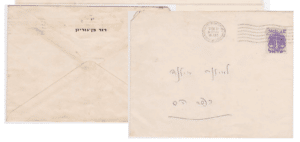
Then Moshe Dayan answered her:
To Ilana Eiland
Greetings
Only this morning did I find the time to write to you, which does not mean I will write you the long and detailed answer that the question you raised deserves… You are absolutely right about the need to preserve Masada in a way that will not lose its uniqueness… The “Snake Path” must go on presenting what was there two thousand years ago (a little less). On the other hand, ways must be sought for Masada to fulfill its educational role for the young and the old…
Of the Tanakh, too, it is said that it was written in the language of human beings, that is, so that everyone could understand it, and no “snake paths” were made in it that only a select few could walk. Therefore, in my opinion, between the ancient Snake Path and an asphalt road of the Public Works Department some “golden path” must be found. I do not rule out, for example, paving rest areas along the way so that people who are not
young, going up on foot, will be able to catch their breath, and so on. And perhaps it is my age (50) and my weight speaking from my throat (I am afraid to get on the scale!
With blessings,
Moshe Dayan
And the excavator of Masada, Yigael Yadin, answered:
Greetings to Ilana
I read your letter of 2/24 with attention and care, and I thank
you for it.
All those engaged in the excavation and restoration of Masada are as anxious as you
and share your dilemmas. The solution will be one that takes into account
the points you raised, though it must be clear that the excavated
and restored site will lose, to a certain extent, its former
character; on the other hand, the visitor there will be able not only to feel Masada
but even to understand it.
With blessings
Yigael Yadin
Either way, the young girl was right in her predictions, and today Masada has kiosks, and hot dogs, and a modern air-conditioned cable car.
But I still insist with my children that when they go up to Masada for the first few times: only on foot, and only by the Snake Path. Only through the feet can one truly understand the ancient events of those days.


