
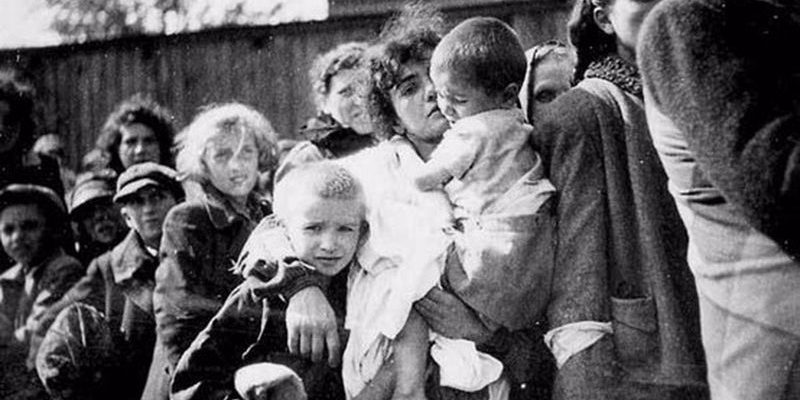
One of the most important insights I have ever received about the phrase “like sheep to the slaughter”:
The pioneers in the Land of Israel said of them that they went like sheep to the slaughter. They called them “soaps.” They could not understand why they did not rebel against the Germans.
Today we are of course gentler about it, but as proud Israelis, we too sometimes find it hard to understand.
The people of the Land, who at times disparaged the people of the Holocaust, who thought they were led along without any choice, failed to understand that it was the exact opposite.
That going to the ghetto, to the Aktionen, to the gas chambers, was not exilic spinelessness. It was truly a choice, a conscious decision. Some would say it was the bravest choice, the most moral one. More than fleeing.
It was a choice of family.
Let us try to illustrate this with a painful picture from hell:
You are a father of three children. The Warsaw Ghetto. You are strong and healthy. You could quite easily climb over the ghetto walls in the dark of night and join the partisans in the forests. But your three children would remain in the ghetto alone, with no one to care for them.
What would you choose? To be a heroic partisan who saves the world? Or to stay faithful to your most basic duty as a human being: to your small children.
Another picture.
You are a young girl on a train. You are with your mother and your two brothers in the horrifyingly suffocating car. You look at the narrow window lit by the pale moonlight. You could climb up and jump. The Germans would not notice in the darkness of night. There is a good chance you would survive. And then you look into your mother’s eyes. At your two little brothers. You choose to stay and hold their hands until the end. You give them security and support, and you do not let go of their hands all the way to the gas chambers.
These scenes played out during the Holocaust in hundreds of thousands of different versions.
Most Jews made an immense moral choice whose price tag was as clear as the clouds of smoke rising from the crematoria. They chose to stay with those closest to them.
Holocaust survivor Israel Gutman tells us of one such decision. He recounts what happened when his friends from the Hashomer Hatzair movement in Warsaw came to call on him to flee with them and establish a cell of resistance:
“Last night Chaimke and Shlomo came to visit me. They told me that these were the last days in which leaving was still possible. Shlomo brought a pair of shoes meant for me. I listened to their words and felt an intense longing flood through me — to leave this place, to be far away from the besieged, miserable city.
I spoke with my parents. My father did not forbid me to go. His eyes were sorrowful, and he said that the weakness in his legs had been growing worse of late and that he feared for his health. Mother did not speak at all, only wept quietly. My sister burst into bitter tears. At that moment they all seemed so abandoned and so helpless, and as if against my will I burst out with a promise that I would not leave them alone — I would stay by their side, come what may. At six in the morning I sought out my friends and told them of my decision. I felt a choking in my throat. They understood” (Israel Gutman, Revolt of the Besieged, page 64).
Notice the words. Not the absence of choice. A hard, clear decision.
Who could flee? Who could truly rebel? Only that narrow age group of older youths who had already left their parents’ authority but had not yet started families of their own. Or those who had already lost everything.
The pioneers in Israel, of course, could never fully understand this. They were the offspring of the “Zionism of rebellion.” Descendants of the people of the Second and Third Aliyah, who grew up on the song “Do not heed, my son, your father’s instruction, and do not incline your ear to your mother’s teaching,” and came to the Land at the age of 20, leaving their families behind in the diaspora.
The Holocaust film “The 81st Blow” takes its name from the testimony of Michael Goldman, who said the Nazis gave him 80 lashes — but when he arrived in the Land and saw the indifference with which the survivors’ stories were received in young Israel, that was the eighty-first blow.
There are, of course, other reasons for the absence of rebellion: the exile and what it did to our people, against its will. The denial. And of course there is the simplest thing of all, which the average Israeli today cannot even begin to grasp — what it means to live in a world that is entirely hostile, all bared fangs, with nowhere to flee and nothing to be done.
But when this idea of the conscious choice of family became clear to me, the whole story of the Holocaust turned over for me. Suddenly, the choice to hold the hands of your loved ones, to protect them and remain faithful to them in hell on earth, became a heroism equal in its nobility and majesty to the heroism of the rebels.
The accursed Nazis exploited the Jewish devotion to family and turned it against us as their most powerful weapon. A weapon that led Jews to put their loyalty to their families before their own lives.
Holocaust and Heroism Remembrance Day.
That heroism has a thousand faces.
A hero is she who slit the German’s throat in the revolt.
A hero is he who gives from his last slice of bread to his brother in the labor camp.
A hero is the mother who did not flee, and held her children close all the way to the pit.
You proved that there is a human image even in the valley of the shadow of death. You proved that there are angels in human form.
****
Deep thanks to Moshe Harmatz, who taught me this great lesson some years ago.


