
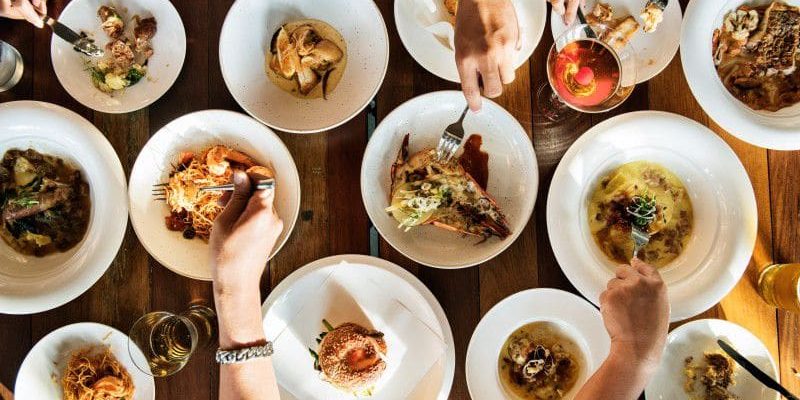
As usual, I am here to save your bank account, your marriage and your health. All this bounty can be yours if you simply obey my iron rule: ‘The Two-Course Rule.’
What does that mean? Listen closely.
In the atmosphere I grew up in, a typical Shabbat evening meal (Friday night dinner, for the uninitiated) looks like this:
First course — fresh challahs, a chopped salad and eighteen more salads of every kind and variety. Now, this course alone far outstrips any regular weekday dinner (leftover ptitim with ketchup that the kids didn’t finish, thanks for asking).
Second course — fish (because how could Shabbat go by without fish? After all, ‘he who eats fish on fish day is saved from F-I-S-H’ — a mind-bending saying, explanation in the comments). At this stage you are entirely ready to retire to the couch for a short nap until the following day.
Third course — a rich soup, complete with soup nuts and croutons. You battle through the soup with your last remaining strength so as not to cause embarrassment, while solemnly swearing on all that is holy that if even one more sesame seed enters your mouth you will explode into pieces, and they had better be prepared to scrape you off the walls.
And then comes the catastrophe. A shout from the kitchen announces that here comes the “main course.” (So what on earth was all that until now?) And here they heap before you swans and quail and carbohydrates and every delicacy, and you start calculating which is more dangerous — not eating, and catching it from whoever slaved over the stove (“so why did I work until two in the morning?”), or eating, and risking death by overdose.
So after so many Shabbatot like these that ended in total bodily collapse, and unimaginable quantities of food consigned to the freezer (Ashkenazim), the trash (Sephardim) or the neighbors’ dog (Rexy of blessed memory, sorry about that experimental cholent), I decided to be brave enough to make a change, and I developed the “Two-Course Rule,” which, like every genius invention, is simple and catchy:
“A Shabbat meal shall never exceed two courses.”
What counts as a course? Salads are a course, fish is a course, soup is a course, a main is a course.
Make any combination you like — but never more than two courses in a single meal.
Want both fish and salads? Excellent. But after the fish, the meal is over. Want a rich main course? Wonderful — then decide whether it is preceded by salads or by soup, but not both.
You will be amazed how natural and right it feels for a Shabbat meal to consist of salads, then a rich soup — and that’s it. Just like that. It is still twice as much as a regular day; there is no need for four times as much.
And so you finish the meal happy, refreshed and brimming with vigor for washing the dishes, reading the kids a bedtime story and taking the late Rexy out for a walk. Hallelujah, baby. (Okay, that’s a lie — you still collapse exhausted on the couch, and the dishes can wait until tomorrow, what’s the big deal.)
By the way — dessert is exempt from the rule. You can always serve it (to the list of the ten worst desserts I will devote a separate academic paper; I will only note that kibbutz-style compote with whole fruit ranks high on the list).
At this point you are nodding along and saying: well, all in all it sounds reasonable — truth be told, we do much the same ourselves quite often. But wait for the extension of the rule, which is where, sadly, most families fall:
The ‘Two-Course Rule’ applies even when you invite guests to the meal.
Aha! I can hear your “good heavens” all the way from here, but yes, yes, I am completely serious. I understand it is hard, because as we all know, when guests are invited to a meal we are convinced it is a MasterChef competition, and that we must demonstrate to the guests our entire culinary repertoire and what a model family we are, where everything is arranged just so, like at “Lavateh Shtertzeh,” with opening courses and intermediate courses and soup and a main — in short, hell both for you and for your guests, whom you have placed in a state of eating far beyond their capacity. And the guests will smile politely and even add, honey-tongued, “Oh, this is wonderful, could we get the recipe?” (I am nearly seventy years old and have never yet had the privilege of someone actually calling afterwards to ask for the recipe). But in their hearts your guests are offering up a silent prayer: God, make the Shabbat timer switch off the lights already so we can clear out of here.
So, if you want people to keep coming over, do yourselves a favor and apply this rule when you host guests as well — like us, for example (third lie of the day; everyone knows the rule that a family with three or more kids no longer gets invited to meals, and a family with five or more no longer invites anyone itself either).
In the future, once the custom spreads through all the communities of Israel, we will have to enforce it on social barbecues and weddings too (after all, the reception dishes before the chuppah alone amount to about five courses, and nobody ever touches the main course at a wedding anyway).
In the meantime, we will settle for being a model family that follows this rule at all times — except on Shabbatot and holidays — and let us say amen.


