
“Man is nothing but the imprint of his native landscape,” said the poet Shaul Tchernichovsky, echoing the view of the Sages, who taught that “the charm of a place rests upon its inhabitants.” Every region of the Land shapes the people who live in it and molds their character. The people of the sands on the plain, the people of the harsh rocky slopes in the mountains, the basalt people of the Golan and the people of the soil in the Jezreel Valley differ from one another not only in geographic location but in temperament. Each tribe of Israel received a particular region of the Land that reflects its character and the “voice” it brings to the people of Israel and to the world.
In what follows we will look at the traits of the tribes destined to receive their inheritance in the mountains of Gilead and in eastern Transjordan, come to understand their unique character, and see its relevance to our own day.
The Firstborn Who Were Passed Over
Four tribes received their inheritance east of the Jordan: Reuben received his inheritance in the south, on the plains of Moab; Gad in southern Gilead; and Manasseh in northeastern Gilead and the Golan Heights. Later they were joined by the tribe of Dan, which settled in the northwestern Golan, just as Moses had already foreseen: “Dan is a lion’s cub that leaps forth from the Bashan” (Deuteronomy 33:22).
These four tribes shared a common denominator that sometimes escapes the eye: they were all the firstborn of the people of Israel. Reuben was Leah’s firstborn; Manasseh the firstborn of Joseph, Rachel’s firstborn; Gad the firstborn of Zilpah; and Dan the firstborn of Bilhah. All the firstborn found themselves east of the Jordan. But these firstborn share something else as well: all of them were firstborn who were passed over for leadership. Reuben the firstborn was replaced by Joseph: “Reuben the firstborn of Israel — for he was the firstborn, but when he defiled his father’s bed his birthright was given to the sons of Joseph son of Israel, so that he is not reckoned in the genealogy as firstborn” (1 Chronicles 5:1). Manasseh, Joseph’s firstborn, was set aside by Jacob, and precedence was given to Ephraim, his younger brother — “yet his younger brother shall be greater than he” (Genesis 48:19). And Dan, firstborn of the handmaids, instead of leading was “the rear guard of all the camps”; the Sages called him “the lowliest of the tribes,” and he did not even have a stable inheritance.
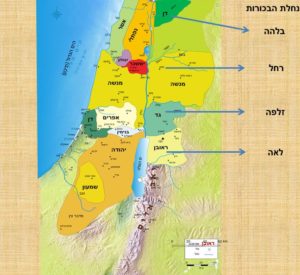
The firstborn who were passed over for leadership were also pushed aside physically, receiving inheritances far from the Israelite heartland. The region where the tribes of Israel dwelt east of the Jordan lies on the plains of the land of Moab, in Gilead and in the Golan, “from Aroer, which is on the bank of the Arnon stream, as far as Mount Sion, that is, Hermon” (Deuteronomy 4:48). East of the Jordan there is a fertile strip along the ridge with rainfall sufficient for farming, but it is surrounded by deserts on every side: to the east, the great Syrian Desert; to the west, the deserts of the Rift Valley; and to the south, the deserts of Edom and Arabia. It is a region with vast expanses for grazing flocks, in the frontier zones between farmland and desert, and this is why it was requested by those tribes of Israel who wished to go on herding flocks on a large scale — as they had done in the wilderness.
Why were all the firstborn of the tribes of Israel passed over? Throughout the book of Genesis we see a pattern of setting the firstborn aside — Abel and not Cain, Isaac and not Ishmael, Jacob and not Esau, Joseph and not Reuben, and so on… But to understand why they were passed over, and why they received Transjordan of all places, let us try to understand the character of these tribes.
Their Faces Were the Faces of Lions
The descriptions of the Transjordan tribes are of fierce, bold warriors. In the blessings of Jacob and Moses to the tribes, these tribes receive especially forceful blessings: of Reuben it is said that he has “preeminence in rank and preeminence in power.” Gad is likened to a preying lion — “he dwells like a lion, tearing off arm and even scalp” (Deuteronomy 33:20); Dan to a pouncing lion — “a lion’s cub that leaps forth from the Bashan” (ibid. 22) — and to a fighting serpent — “that bites the horse’s heels so that its rider falls backward” (Genesis 49:17). In the book of Chronicles the Transjordan tribes are described as skilled fighters: “The sons of Reuben and the Gadites and the half-tribe of Manasseh, of the men of valor, men who bore shield and sword, drew the bow, and were trained for war” (1 Chronicles 5). One beautiful, remarkable verse describes the might of the sons of Gad in vivid language: “who handled shield and spear, whose faces were the faces of lions, and who were as swift as gazelles upon the mountains” (1 Chronicles 12:9). The power of a lion, the swiftness of a gazelle. Later in that chapter we are told that they managed to cross the Jordan at the height of its flooding — an extraordinary feat befitting the finest of Israel’s warriors.
The warriors of Transjordan swore to Moses on the plains of Moab that they would cross over “as a vanguard before the camp.” That oath they kept in full. The sons of Reuben and Gad were the fighters who led all the wars of conquest of the Land in the days of Joshua. The army as a whole may have numbered some 600,000 men, but most were not fighters. The fighting spearhead that stood beside Joshua was the 40,000 vanguard troops of the sons of Gad and Reuben. According to the book of Joshua and the midrashim of the Sages, these tribes were the vanguard in all the wars of the conquest of the Land: they were the first to cross the Jordan, they were the force that conquered Jericho, they were those 40,000 who fought in the battle of Ai, and they were Joshua’s retinue in all his wars to conquer the Land. The Land of Israel was conquered thanks to the heroism of the tribes of eastern Transjordan. Joshua knew how to show them gratitude, and the midrash describes the bond and the love between the Transjordan tribes and Joshua son of Nun, a brotherhood of warriors forged over the fourteen years of the conquest and division of the Land: “For while Israel were conquering and dividing the Land, the tribes of Reuben and Gad were with them, and they spent fourteen years… Rabbi Yudan said: the tribes of Reuben and Gad were Joshua’s retinue, and he escorted them to the Jordan; and when they saw that his retinue had dwindled, they turned back and escorted him all the way to his home” (Bereshit Rabbah 35:4). This moving midrash describes the intimate bond between the leader and his finest warriors: when the conquest of the Land was complete, Joshua escorted them from Shiloh to the Jordan, and when the sons of Gad and Reuben saw that Joshua would be returning to Shiloh nearly alone, they turned around and escorted him back to Shiloh..
The tribes of Transjordan, the firstborn of the people of Israel, merited being first in a whole range of ways — they were the first in the conquest of the Land and in the army, and they were the first to receive an inheritance in the Land of Israel.
What Is a Pioneer?
The power of “firstness” of the sons of Gad and the sons of Reuben can be captured in a single word: pioneering. The Hebrew root ch-l-tz appears more than thirty times in the Bible, and the overwhelming majority of those occurrences refer to the sons of Gad and Reuben, with the word chalutz — vanguard, pioneer — repeated again and again in the Bible’s descriptions of these tribes: “every man armed for war,” “we ourselves will cross over swiftly armed before the children of Israel,” “we will cross over as a vanguard before the Lord,” “and the vanguard went before them,” “the heads of the vanguard of the army.”
What is pioneering? Pioneering is not merely “being first,” nor is it merely “heroism.” Pioneering is total devotion to an idea, together with the willingness to sacrifice and to leave much behind. Jabotinsky, following his conversation with Trumpeldor, defined it precisely:
“A pioneer is a far broader concept than “one who marches at the head.” Of course workers are needed too, but that is not the meaning of the word “pioneer.” We need people who are ready for “anything” — for whatever the Land of Israel may demand… We must raise a generation that has no interests and no habits. A plain bar of iron. Flexible — but iron. Metal from which one can forge whatever the national machine requires. Is a wheel missing? I am the wheel. A nail, a screw, a flywheel missing? Take me. … I am the pure idea of service, ready for anything; I am bound to nothing”.
The sons of Gad and Reuben were certainly such people. They left their wives and children behind and were prepared to set out on the pioneering mission of conquering the Land for seven years. “While Israel were conquering and dividing the Land, the tribes of Reuben and Gad were with them, and they had left their children small; one who was left behind at ten was found again at twenty-four… and these grew their hair and those grew their hair — these grew their hair until they should see their sons, and those grew their hair until they should see their fathers” (Bereshit Rabbah 98:21). They were utterly devoted to their mission and willing to carry it out totally — so much so that the Sages said, “any condition that is not like the condition of the sons of Gad and the sons of Reuben is no condition” (Kiddushin 61a).
It is interesting to note that in Zionist history the title “pioneers” was given mainly to the people of the Second and Third Aliyah, while the people of the First Aliyah, even though they came before them, are usually called “farmers.” Here is a direct continuation of the sons of Gad and Reuben. The people of the First Aliyah mostly came to the Land with their families and founded family-based communities. The people of the Second and Third Aliyah, by contrast, mostly came alone, leaving their families behind. This is the totality of idea and fulfillment, even at a heavy personal price — exactly like the sons of Gad and Reuben, who left their families behind.
When Pioneers Try to Lead
But there is also another side to the pioneering, trailblazing powers and the heroism of the Transjordan tribes. The Transjordan tribes possess tremendous force, but their ability to control that force is limited and hard to rein in. They are pioneers, always first to volunteer, but that firstness can be destructive without proper regulation. This is well reflected in the character of Reuben, who comes across as an authentic, impulsive figure crying out from the depths of his heart, “and I — where can I turn?” at the sale of Joseph, yet failing to take command of events; and later, when Jacob must be persuaded to let them go down to Egypt to bring food, he makes an extreme offer: “You may put my two sons to death if I do not bring him back to you; place him in my hands, and I will return him to you.” Jacob, who knows his son, knows that the firstness of his firstborn also showed itself in excess, at times without forethought — “preeminent in rank and preeminent in power. Unstable as water” (Genesis 49:3). A boldness that is sometimes too much and sometimes too hasty.
Pioneering is a character trait. The pioneer harnesses the boldness and the firstness ingrained in him to the mission of conquest — conquering the wilderness or military conquest. He fares well in war — “the kingdom of uncertainty” — where that very impulsiveness, totality and trailblazing energy express themselves in initiative, creativity, daring and heroism that push the whole of society forward. But what happens when pioneers try to lead?
At the end of the days of the Kingdom of Israel in the biblical period, short-lived kings rise one after another, unable to hold power, murdering one another, until in the end the Kingdom of Israel is destroyed by Assyria. What these kings had in common is that most of them came from the mountains of Gilead: “Shallum son of Jabesh became king in the thirty-ninth year of Uzziah king of Judah, and he reigned one month in Samaria” (2 Kings 15) — Shallum son of Jabesh, of Jabesh-Gilead. And immediately after him: “Then Menahem son of Gadi went up from Tirzah and came to Samaria, and struck down Shallum son of Jabesh in Samaria and killed him, and reigned in his place” (2 Kings 15). Menahem son of Gadi, whose father’s name testifies that his origin was among the sons of Gad. Menahem’s dynasty was cut off by “Pekah son of Remaliah, his officer, who struck him down in Samaria, in the palace… and with him were fifty men of the Gileadites; he killed him and reigned in his place.” Pekah too relied on the men of Gilead in order to rebel. In the days of Pekah son of Remaliah the Gileadite, Pekah and Rezin king of Aram tried to crown in Judah as well a distinguished family from Gilead, the family of Tobiah, in order to shake the kingdom: “Let us go up against Judah and terrorize it, and let us breach it for ourselves and set up the son of Tabeel as king within it” (Isaiah 7:6). Bible scholars show how Aramean and Assyrian interests joined together to give power to the men of Gilead so that they would seize the throne in Israel and Judah and foment unrest from within.
The very forces that served so well in the hour of conquering the Land are exactly the forces that can — and indeed do — destroy, agitate and bring about ruin. The firstness of the men of Gilead was also expressed in their being the first to go into exile, as the midrash so aptly describes:
“An inheritance gotten hastily at the beginning — for they were anxious to rush and take theirs first, like the sons of Gad and the sons of Reuben, who hurried to take their portion east of the Jordan and spoke in haste…
but its end shall not be blessed — for they were exiled several years before the other tribes”
(Rashi on Proverbs 20:21).
Haste is the other side of the coin of pioneering. A restless firstness that decides without thinking things through to the end. That is why they were the first to settle the land — and also the first to go into exile.
Similar things happened in the days of the young state as well. The fighters of the Palmach, men and women alike, had everything needed to found a state: pioneering expressed in initiative, daring and determination. Pioneers need space and freedom. Rules constrain them. In the pre-state period, a time of disorder and lack of discipline, they flourished. But Ben-Gurion knew that for precisely this reason the Palmach could not be allowed to remain. With the founding of the state, an orderly, non-partisan army was needed. And this is how the Palmach fighter Netiva Ben-Yehuda, in her colorful language, describes the disbanding of the Palmach:
“Those drecks from ‘Kiryati’ — they’ve beaten us! They’re screwing us! … So that the Palmach will be exactly like those chocolate soldiers! They’re breaking up our brigades, our battalions, and they’ll scatter the whole Palmach through the army! And there’ll be a new oath, to the IDF! They don’t trust our Palmach oath! And there’ll be uniforms! And they’ll start with the saluting! And they’ll have separate mess halls for officers and for the plain grunts! And they’ll hand out ranks! And only to whoever agrees to all of it!”.
(Ben-Yehuda, Netiva. 1991. When the State Broke Out: A Docu-Novel. Jerusalem: Keter).
Something similar happened with Unit 101. It arose in a time of crisis out of a band of “reckless” men (“unstable as water”) who could not fit into the ordinary frameworks, but it was precisely this quality that enabled them to pull the young army out of the fossilization into which it had sunk. Not for nothing were many veterans of this unit drawn like a magnet to crossing borders in general and into eastern Transjordan in particular. The treks to Petra and to Jordanian Jerash, begun by Meir Har-Zion and continued by many of that generation, symbolized the inability of these boundary-breaking men of fire to settle into the orderly army. As in the Palmach, in Unit 101 there were no hierarchies and no clear rules, neither in training nor in battle. The pioneering spirit alone sufficed. It is no accident that the members of these units longed for the Palmach era and tried to recreate it. War and the absence of boundaries are their finest hour. And here too, Ben-Gurion knew that establishing a militia with a “Gileadite” character could only ever be a temporary measure, and he disbanded Unit 101 in order to spread those tremendous forces across all the units of the IDF. Interestingly, the most famous veterans of these units chose to live on isolated ranches, far from institutionalized society. They built their ranches facing the landscapes of Transjordan, which so mirror their stormy souls: Meir Har-Zion at Kokhav HaRuchot facing Gilead, and Kushi Rimon at the 101 Inn facing Petra.
Throughout history we know of many leaders with a “Gileadite” character. Superb and outstanding in times of trouble, but failing at the management of routine. Jephthah the Gileadite is the archetype of such leaders. He delivered a tremendous victory over the Ammonites in the war against the sons of Ammon, but failed utterly at managing routine and brought about a civil war with 40,000 dead. In our own day he is strongly reminiscent of Ariel Sharon: a formidable commander in times of trouble (founding Unit 101, Abu Ageila in the Six-Day War, handling Gaza in the War of Attrition, crossing the Canal in the Yom Kippur War, and crushing the Second Intifada), but a leader inclined to get entangled and to run afoul of the law in routine times. Churchill was the same. The English people chose him to run the Second World War precisely because of his wild, unyielding character, even though he promised them nothing but “blood, sweat and tears.” Yet, almost incomprehensibly, the mighty leader who led Britain to victory suffered a stinging defeat in the elections held immediately after the war ended in 1945. The English people understood with their sharp instincts: the great leader who had led the war with such determination would not be able to run the country in times of peace.
Afterword
Each of the tribes of Israel has its character traits and a particular calling it can fulfill. The power within every tribe, in the right balance of time and place, can bring great blessing; out of balance, that very same power can bring disaster. The geographic location the Transjordan tribes received suited the character of these tribes exceptionally well. There, alongside permanent settlement, one could make a living from herding flocks — which does not demand a settled bourgeois life — and from wandering through wild desert regions well suited to the burning souls of the sons of Gilead. The firstborn energies and the firstness of the men of Gilead were converted into the powers of pioneering. The “vanguard” power of the Transjordan tribes is immensely useful in times of trouble and confusion, but can bring disaster in routine. Yet the dwelling of these tribes in the east, far from the centers of influence, in fact gave them a place of honor in routine as well: they were the defensive wall of the Land of Israel against the marauders of the desert and against the northern threat. Thus they in effect lived in a region prone to calamity, a region of constant uncertainty — exactly suited to their character, which “blossoms” in such situations. And when the need arose, leaders also rose up from Gilead to shake and jolt the people of Israel when it had forgotten its way. So it was with Elijah the prophet, and with the first of the prophets, Hosea son of Elah of Gilead, who called on the people of Israel to return to its pure desert origins. Not for nothing was it precisely in Gilead, at the ford of the Jabbok, that Jacob received the name “Israel” — a name that signifies striving, war, struggle and daring, with men and even with God.
And looking to our own day:
It is easy for the institutionalized State of Israel to ignore the rebellious, reckless, impudent and daring forces. Indeed, these are forces that would be dangerous to have leading permanently. On the other hand, these forces must be given a place in society. These are the forces that set things in motion, that shake things up, that create new orders of the world — and in a time of trouble, we will all need them. Today the IDF tends to promote not the impudent and the daring but the normative ones who never get into any trouble — yet who also do not necessarily know how to decide, to lead and to win. A society that seeks life must know how to make room, alongside the law, for the lawbreakers too. Not to desire only lazy, quiet horses, easy to tame but hard to spur into a gallop, but to know how to get along with the wild horses as well.