
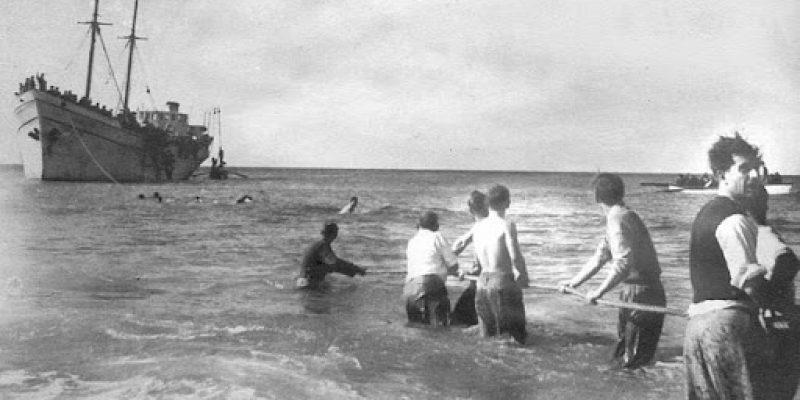
My favorite sin in the entire Tanakh appears in Parashat Shelach: the sin of the Ma’apilim. And there is a deep connection between those ancient Ma’apilim and the Ma’apilim who founded the State of Israel.
The story in brief:
After the Children of Israel were forbidden to enter the Land and condemned to wander the desert for forty years, a few brazen people, lovers of the Land and of earthly life, arose and decided to try to conquer the Land anyway, without asking anyone’s permission. They failed spectacularly; the Canaanites struck them down utterly.
Despite the failure, they apparently succeeded at education. The midrash tells us that the daughters of one of the Ma’apilim were the daughters of Tzelophchad — Hoglah, Milcah, Tirzah, Noa and Mahlah. Daughters who are among the great lovers of the Land in the Bible, daughters who demanded “Give us a holding” — give us a hold on the Land, we too want a share in it — and they indeed settled a huge area in northern Samaria.
The word that describes those climbers in our parashah is a word that carries a touch of chutzpah and defiance — “ha’apalah.” And that word made a spectacular historical journey all the way to the days of Zionism.
A large part of the Zionist aliyot were aliyot of defiance against views that held it was forbidden to go up, and that one must still remain in the “desert of the nations” of the exile. In the days of the White Paper, this defiance was directed against the British Empire as well, and the immigrants in the rickety ships who thumbed their nose at the whole world were called — Ma’apilim.
There is no name more fitting. There is no greater honor. A brazen ascent — only that unlike 3,300 years ago, this time the descendants of the desert Ma’apilim succeeded spectacularly.
The one who, two hundred years ago, already offered a great defense of the Ma’apilim of our parashah, is the one who in effect foresaw the Ma’apilim who would found the state — R. Tzadok HaKohen of Lublin.
He argued that the Ma’apilim did what they did out of great love, and out of the understanding that their act would draw the supreme will after them. According to R. Tzadok, they were simply ahead of their time. He makes an astonishingly precise reading of the words Moses said to the Ma’apilim: “and it shall not succeed,” and says: “Note the precision: ‘and it’… shall not succeed now… for there is another time when it succeeds, and that is this time of ours, for at the heels of the Messiah chutzpah shall increase, and then is the time for this…” (Tzidkat HaTzaddik, 46).
Astonishing. He is in effect saying that the time is coming when the chutzpah of the ancient Ma’apilim will be needed — and then it will succeed! And that is exactly what happened, at the hands of those who were called — Ma’apilim.
(And Chanan Porat, a man of light, wrote about this better than I have, in his book Me’at Min HaOr on our parashah.)
One of Bialik’s most famous poems is “The Dead of the Desert.” A poem that calls to shake off the desert of exile. The entire poem converses with the two stories in our parashah, the sin of the spies and the sin of the Ma’apilim. Bialik uses many words from the story of the Ma’apilim in our parashah, and says — even if it seems that God is not with us — this time we will go up and succeed. Here are his thrilling words:
At that hour —
Suddenly, all at once, a generation fierce and mighty shall shake itself awake, a generation mighty in war…
They call out:
“We are heroes!
The last generation of bondage and the first of redemption are we!
Our hand alone, our strong hand
has cast the heavy yoke from off our proud neck….
If God has withdrawn His hands from us
and His ark does not move from its place —
then let us go up without Him!
And beneath the eye of His wrath, the lightning of His furious gaze,
let us tread down before us these towering mountains,
and come face to face with the armed foe!
Listen!
The storm, too, calls to us: “Dare!”
To the swords! To the spears! Let the mountains be shattered, let the hills break apart
or let our corpses fall in heaps upon heaps —
here we are, and we shall go up —
up the mountain!
(The Dead of the Desert — Chaim Nachman Bialik — Adar I, 5662 [1902], Odessa).
And as I have written before: secularism is not disbelief in God. It is simply a great belief in the power of man and in his ability to decide, seemingly even against God, when necessary. For it is not in heaven. Like Gideon the judge, like Rabbi Yehoshua ben Chananiah, like Rabbi Levi Yitzchak of Berditchev, like the Ma’apilim.


